Top 5 Inventory Management Tools Every Business Needs
Built For


5 inventory tools to help with inventory control and management
Inventory management can make or break a business. When inventory isn’t properly controlled, companies face challenges like missed sales opportunities, excess stock tying up cash, and costly stockouts that frustrate customers. As businesses grow and sales channels multiply, keeping inventory accurate and balanced becomes even more complex.
The right inventory management tools help bring order to that complexity. From monitoring stock levels to improving purchasing decisions and increasing visibility across locations, modern inventory systems give businesses the insight they need to operate more efficiently. In this guide, we’ll break down five essential inventory management tools every business should have—and how each one supports better inventory control and smarter decision-making.
What Are Inventory Management Tools?
Inventory management tools are the features and functions within an inventory management system that help businesses track, control, and optimize their inventory. These tools provide visibility into stock levels, product movement, and demand trends so teams can make informed purchasing, sales, and fulfillment decisions.
Rather than relying on spreadsheets or manual processes, inventory management tools automate key tasks like monitoring inventory levels, generating insights, and coordinating activity across departments and locations. When used together, they help reduce errors, improve accuracy, and ensure the right products are available at the right time to support daily operations and long-term growth.
How Inventory Management Tools Help Solve Common Inventory Challenges
Inventory management tools are designed to solve everyday inventory challenges that prevent businesses from operating efficiently. Without the right tools in place, companies often struggle with inaccurate inventory counts, delayed reordering, excess stock, and limited visibility across locations.
By using inventory control tools like automated alerts, inventory tracking systems, and real-time reporting, businesses can better manage inventory levels, reduce carrying costs, and avoid stockouts. These tools also help teams respond faster to demand changes and maintain consistent service levels as operations grow.
Key Benefits of Using Inventory Management Tools
Inventory management tools help businesses move beyond basic stock tracking and gain better control over inventory across locations, channels, and teams. When used as part of an inventory management system, these tools support more efficient operations, stronger inventory accuracy, and better decision-making.
Improved Inventory Accuracy
Inventory management tools reduce the risk of human error by automating inventory tracking and updates in real time. Instead of relying on manual data entry, businesses can trust their inventory data to reflect actual stock levels. Benefits include:
- Fewer discrepancies between physical and system inventory
- More reliable inventory counts and adjustments
- Greater confidence in inventory availability
Better Inventory Control & Visibility
With centralized inventory control tools, businesses can see stock levels across warehouses, stores, and sales channels from one system. This visibility makes it easier to manage inventory proactively rather than reacting to issues after they occur. Benefits include:
- Faster identification of low or excess stock
- Clearer insight into inventory by location or product
- Improved coordination between purchasing, sales, and operations
Reduced Stockouts & Overstocking
Inventory management tools help businesses strike the right balance between too much and too little inventory. By using tools such as reorder alerts and inventory analysis, teams can plan purchases based on demand rather than guesswork. Benefits include:
- Fewer lost sales due to out-of-stock items
- Lower carrying costs from excess inventory
- More consistent product availability for customers
Time Savings Through Automation
Managing inventory manually can be time-consuming and inefficient. Inventory management tools automate routine tasks such as tracking inventory levels, generating reports, and updating stock across systems. Benefits include:
- Reduced manual inventory tracking efforts
- Less time on administrative tasks
- More focus on strategic inventory planning
Smarter Purchasing & Planning Decisions
Inventory management tools provide access to historical data, demand trends, and inventory performance metrics. This insight allows businesses to make informed decisions about purchasing, stocking, and forecasting. Benefits include:
- Greater accuracy in planning inventory purchases
- Aligning inventory levels with customer demand
- Long-term inventory and growth strategies
Scalable Inventory Management as the Business Grows
As businesses add products, locations, or sales channels, inventory complexity increases. Inventory management tools scale with the business, providing the structure and flexibility needed to manage inventory efficiently over time. Benefits include:
- Support for multi-location inventory management
- Consistent inventory processes as operations expand
- Greater control without adding unnecessary manual work
Top 5 Inventory Management Tools
Inventory management software systems like Acctivate provide a wide range of features and tools to help with inventory control. Here are five powerful inventory tools in inventory management software, along with a description of what they are and the benefits of each.
Reorder Alerts

What It Is:
Reorder alerts, or low inventory alerts, will appear in your inventory management system to alert the user(s) of when it’s time to reorder a certain item. The alert will appear when the product level reaches the predetermined reorder level. The inventory management system is able to do this because it is able to see the amount of each product (even if they are in multiple locations, warehouses, etc.), and see when the overall product level has become “low”.
How to Use It:
By considering certain inventory information, such as previous sales history and expected demand, you can determine the necessary amount of buffer or safety stock for each specific item. Then, you can set the reorder alert based on this amount.
Benefits:
Benefits of reorder alerts are:
- Reduction in time spent looking up inventory levels and purchasing
- Reduction in manual efforts to look up inventory levels
- Increased accuracy of inventory levels through automation.
Additionally, inventory management software may be able to make the purchasing component of reordering products even easier and quicker.
For instance, with Acctivate for QuickBooks inventory software, you are able to generate a purchase order straight from the reorder alert. This makes it easy to know when a product level is getting low and reorder that item right away. Therefore, inventory levels are quickly restored and your business is able to have a better inventory control measure in place.
2. Reports

What It Is:
Reports can be created using the report function in an inventory management system. The data and information is pulled from the system’s database to create a report with all of the pertinent information necessary. Examples of categories of the types of reports and documents available include:
- Inventory reports
- Sales reports
- Purchasing reports
Reports can be standard, meaning they are already available in the inventory management system. Alternatively, reports can be customized, meaning they are a modified or altered version of a standard report or personalized for a business in order to display specific information desired.
How to Use It:
There are many reports and documents available that can all be used in a variety of ways. Depending on the exact inventory management software system, both standard and custom reports may be available. Acctivate includes over 70 standard reports and has the ability to create custom reports using its integration (we’ll cover system integration later) with Crystal Reports®.
The reports can be used to determine optimum inventory amounts down to the product level by displaying information such as:
- Inventory analysis by product
- Sales history by a specific customer
- Inventory information by lot or serial number
- Inventory reorder reports that display all products needing to be reordered
Benefits:
The benefit of reporting is that you are able to see a comprehensive and detailed amount of information at once. This is a time and effort-saving alternative to manually looking up all the data and/or information separately. Additionally, because reports are an automated way of collecting information, potential for error is greatly reduced.
3. Dashboards

What It Is:
In an inventory management software system, a dashboard is an on-screen graphical display of information. Different information and data, which have been pulled from the system’s database, can be viewed from the dashboard. For instance, Acctivate allows users to customize the information that is shown on their dashboard screen.
Here is a screenshot of the dashboard feature in Acctivate:
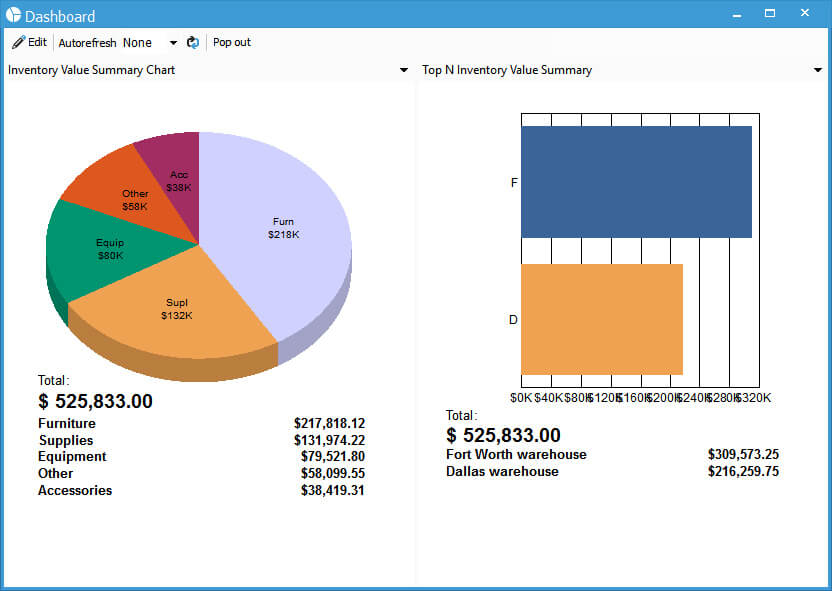
As you can see, Acctivate’s dashboard feature displays graphical information, which can be customized to each user’s preferences. This dashboard example displays an inventory value summary broken down by category, as well as by warehouse.
How to Use It:
Depending on the user(s) and their roles in the business, the dashboard can be used in a variety of ways to display a wide range of information. For instance, a small business owner could use their dashboard to display information such as monthly sales information, inventory levels per location, etc. On the other hand, a warehouse manager might use their dashboard to display current inventory levels in their warehouse, orders that are scheduled to be received and shipped out, etc.
Benefits:
Again, such as with reports, a dashboard is a great tool for compiling assorted data and information. Because the inventory management system collects and displays this multitude of information, both time and effort are saved, while accuracy is increased.
4. Barcoding and mobile systems

What It Is:
Barcoding and mobile systems are a combination of hardware and software that allow your business to assign, scan, and manage barcodes. Barcode hardware includes items such as barcode scanners and label printers. Barcode software is the system that manages the barcoding and inventory information.
How to Use It:
For an effective inventory management system, barcoding and mobile solutions can be utilized to:
- Conduct inventory counts
- Verify inventory
- Adjust inventory
Benefits:
The benefits of using barcoding and mobile systems are ease, speed, and accuracy. For instance, conducting an inventory count by using a barcode scanner is easier, quicker, and more accurate than conducting an inventory count manually.
5. System integrations

What It Is:
An inventory management software system is able to integrate with other business management systems, such as accounting software, webstore platforms, and EDI, just to name a few.
How to Use It:
Depending on the services your business uses, the system integrations necessary will differ. Examples of systems that can integrate with your inventory management software include:
- Accounting software integration
- Web store integration
- 3PL and/or EDI integration
- Reporting software integration
Benefits:
With inventory management software system integration, inventory levels can be seen from a bird’s-eye view from across channels (brick-and-mortar stores, web stores, phone orders, etc.) and locations. Then, inventory can be examined with precision by location, warehouse, product, etc. This gives businesses better insight and information in which to carry out purchasing, sales, and inventory decisions.
Finding Solutions for Inventory Control, Tracking, & Management with the Right Inventory Tools
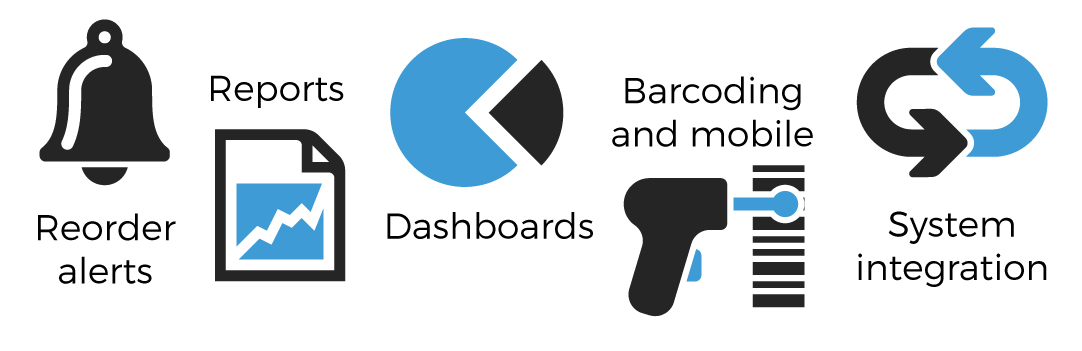
To summarize, five powerful inventory tools to utilize in inventory management software include: reorder alerts, reports, dashboards, barcoding and mobile, and system integration. Inventory management software also has many other dynamic features and tools to help with inventory control and management. The best part is, inventory management software is affordable and cost-effective, meaning small to mid-size businesses are able to harness the power of inventory management software. Now small and mid-size businesses can reap the benefits of a powerful and robust system.
Inventory Management Tools FAQs
What are inventory management tools used for?
Inventory management tools are used to track inventory levels, manage stock movement, and maintain accurate inventory data across locations and sales channels. They help businesses reduce stockouts, prevent overstocking, and make more informed purchasing and planning decisions.
What types of inventory management software are available?
There are several types of inventory management software designed to support different business needs. These include basic inventory management software for small businesses, multi-location inventory systems, industry-specific inventory software, and fully integrated inventory management platforms that connect with accounting, ecommerce, and fulfillment systems.
What are some examples of inventory management software?
Inventory management software examples include standalone inventory tracking systems, inventory management software products that integrate with accounting platforms, and end-to-end inventory management systems that support reporting, automation, and system integrations. The best option depends on the size and complexity of the business.
What is the difference between inventory management and inventory control?
Inventory management focuses on the overall strategy of managing stock, including forecasting, purchasing, and planning. Inventory control refers to the day-to-day processes and tools used to track inventory levels, monitor movement, and maintain accuracy. Inventory management software typically supports both functions.
What is the best inventory management software for small and mid-sized businesses?
The best inventory management software for small and mid-sized businesses is one that offers strong inventory tracking, automation, reporting, and integration capabilities without adding unnecessary complexity. Many growing businesses benefit from software that scales as inventory volume, locations, and sales channels increase.
Can basic inventory management software support business growth?
Basic inventory management software can support early-stage businesses, but it may become limiting as operations grow. As inventory complexity increases, businesses often need more advanced inventory management tools such as automated reorder alerts, real-time reporting, and system integrations.
Do inventory management tools work with accounting and ecommerce systems?
Many inventory management software products are designed to integrate with accounting systems, ecommerce platforms, and fulfillment solutions. These integrations allow inventory data to stay synchronized across systems, improving visibility and reducing errors.
How do businesses choose the right inventory management software?
When choosing inventory management software, businesses should consider inventory volume, number of locations, reporting needs, and integration requirements. Evaluating different inventory management software and understanding available features can help identify the best solution.
Acctivate: Inventory Management Tools for Long-Term Business Success
With the right inventory management tools in place, businesses can gain better visibility, improve inventory accuracy, and make smarter decisions across purchasing, sales, and operations. The key is choosing tools that fit today’s needs while supporting future growth.
Acctivate, a CAI Software solution, helps businesses take control of inventory with powerful tools designed to simplify inventory tracking, automation, and reporting. Whether you’re looking to reduce stockouts, streamline workflows, or gain clearer insight into inventory performance, the right inventory management software can make a measurable difference.
Learn more about Acctivate or contact CAI Software today!
Call us at 817-870-1311